Positioning errorsHidden individuals
Motion blur
Exposure artifacts
Photographic limitations
From a historical perspective, these explanations are far more probable than paranormal interpretations.
Extraordinary claims require extraordinary evidence.
A strange-looking hand alone rarely meets that standard.
Yet acknowledging a likely explanation does not eliminate the photograph’s fascination.
Part of its appeal lies in the questions it raises rather than the answers it provides.
A Window Into Another Era
Beyond the mystery itself, the photograph offers something equally valuable.
It provides a connection to people who lived more than 150 years ago.
The siblings in the image were real individuals with hopes, fears, relationships, and daily routines.
They inhabited a world dramatically different from our own.
Railroads were expanding.
Industrialization was transforming societies.
Photography was still relatively new.
Every portrait represented a meaningful investment.
The image allows us to glimpse that world, even if only briefly.
The Power of a Single Detail
It is remarkable how one small detail can transform an otherwise ordinary photograph.
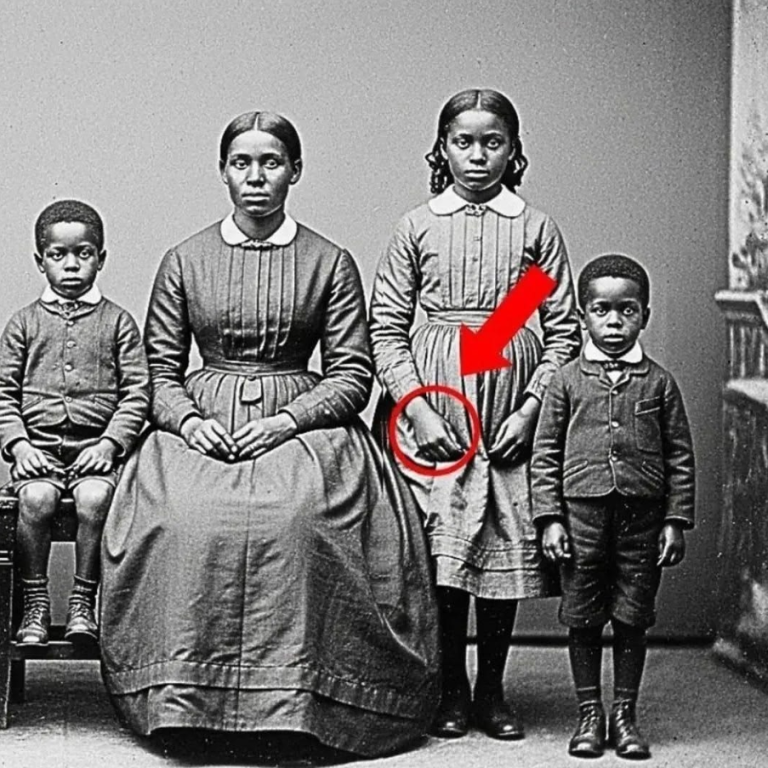
Without the hand, the image might have remained largely forgotten.
With it, the photograph becomes a conversation piece.
Researchers analyze it.
Viewers debate it.
Writers discuss it.
The hand functions as a focal point for curiosity.
It demonstrates how attention often gravitates toward anomalies rather than familiar elements.
The photograph’s mystery is not merely visual.
It is psychological.
Lessons from the Photograph
The story teaches several broader lessons.
First, appearances can be deceiving.
What initially seems mysterious may have a perfectly reasonable explanation.
Second, historical context matters.
Understanding nineteenth-century photography helps prevent modern misunderstandings.
Third, curiosity remains one of humanity’s most enduring traits.
People are naturally drawn to unanswered questions.
Even in an age of advanced technology, a century-old photograph can still capture the imagination.
Conclusion
What began as a simple family portrait from 1872 has become an enduring mystery thanks to one unusual detail: the sister’s hand.
Whether the result of photographic limitations, an unseen individual, a technical error, or something else entirely, the image continues to intrigue viewers more than 150 years after it was taken.
The fascination surrounding the photograph reveals as much about us as it does about the people captured within the frame. We are storytellers by nature. We seek explanations, patterns, and meaning. When confronted with ambiguity, our imaginations rush to fill the gaps.
Perhaps the true mystery is not the hand itself.
Perhaps the real mystery is why certain images continue to captivate us across generations.
A family posed for a photograph in 1872, expecting little more than a keepsake.
Instead, they unknowingly created a puzzle that would outlive them all.
And today, as viewers continue examining the image and debating its secrets, the photograph serves as a reminder that sometimes the smallest details leave the biggest impression.