On the morning of my wedding, my sister cried before me.
Lori was behind me in the church hall, her hands covering her mouth, staring at my reflection as if she could still see the thirteen-year-old girl I used to be, beneath the lace and carefully applied makeup.
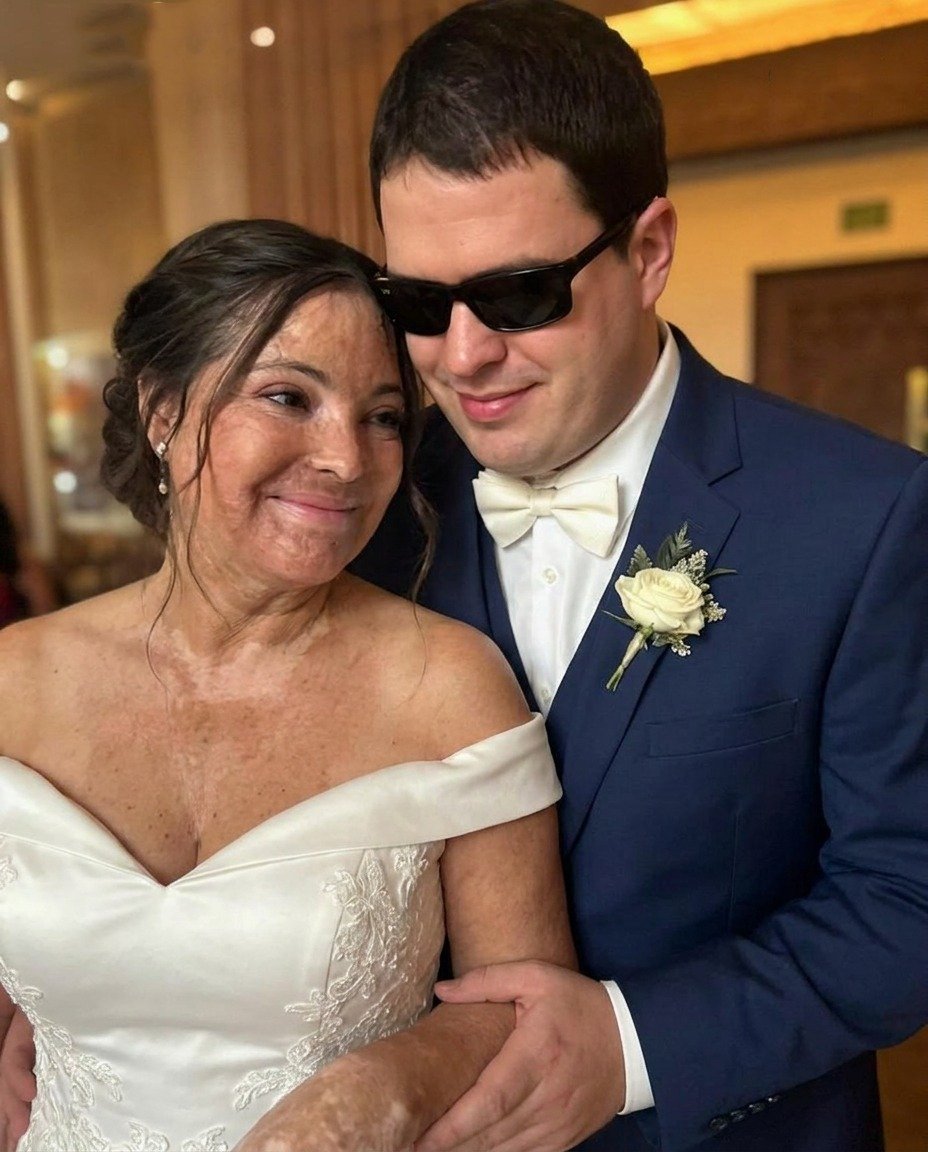
My dress was ivory, with long sleeves and a high collar, chosen for both its concealment and its elegance, though Lori insisted it was beautiful until I finally allowed that word to exist in the room without arguing with her.
"You look beautiful, Mary," she whispered, as tears streamed down her face.
Beautiful.
That word still holds something inside me. When I was thirteen, I heard a very different word while lying in a hospital bed, half my face burning and every breath I took feeling like it was borrowed.
A police officer told me that a neighbor must have handled the gas improperly. That would have caused the explosion. He said I was "lucky" to have survived.
Luck meant waking up alive in a body I no longer recognized. It meant hearing children whispering at school and adults looking at me with a gentle pity that hurt even more.
Our parents were already dead by then. Our aunt raised us for a while, but she too died, leaving Lori, at eighteen, to take on a life she never asked for and be everything to me at the same time. She was the one who ran after the ambulance that day and endured every silent humiliation of my recovery.
My sister stood in front of me on my wedding day and asked me softly:
Are you ready?
I wiped my eyes and nodded. Then I walked towards the man who changed my life.
I met Callahan in the basement of the same church where we were going to get married.
He gave piano lessons to children three afternoons a week. The children were always wrong in their timing and singing louder than they played. The first time I heard him, he corrected a little boy's timing with more patience than I had ever heard in a male voice.
"Again," Callahan said softly. "Calm down this time, champ. The music's not going anywhere!"
I smiled before I even saw him.
He sat at the piano, wearing sunglasses. One hand rested lightly on the keys, while the other stroked the back of the ears of the golden retriever sitting next to him. Buddy wore a harness and had the deeply patient expression of a creature who already understood everything about life.
At the time, I was thirty years old and had almost never been in a serious relationship. The men I knew only saw my scars. Over time, I got tired of those looks.
No one seemed willing to search hard enough to find my heart. They only saw someone hurt.
But Callahan was different. Even without being able to see, he could see me.
On our first date, I looked across the table at the restaurant and whispered:
"I have to tell you something, Callie. I'm not like other women."
⏬️ ⏬️ continued on the next page ⏬️ ⏬️
He smiled and reached across the table to take mine.
"That's good. I've never been interested in ordinary things."
I laughed so hard I almost cried. Maybe that should have warned me earlier.
When Lori placed my hand in his in front of the altar, all those tender memories already filled my eyes with tears.
Callahan stood there with Buddy by his side, wearing a black bow tie that one of his students had picked out. These same kids were supposed to sing a romantic song as I walked down the aisle. What they actually produced was a courageous, dissonant rendition, full of wrong notes and determined effort. It was awful in the sweetest possible way.
When the pastor asked if I accepted Callahan as my husband, I answered "yes" before he even finished the sentence.
Then there were hugs, cheap cake, paper cups of punch, kids running under the folding tables, and Lori pretending not to wipe her tears every time she looked at me.
For the first time, I wasn't the scarred woman everyone was politely trying not to notice.
I was the bride.
Lori took us to Callahan's apartment after sunset. Buddy went in first, exhausted from all the attention, and collapsed near the bedroom door with the heavy sigh of a dog who had fulfilled all his duties.
My sister hugged me tightly at the door.
"You deserve this, Mary," he whispered. "I'm so happy for you."
Then he left, and suddenly it was just me and my husband, surrounded by the first silent moments of our marriage.
I led Callahan into the bedroom, holding his hand. When we reached the edge of the bed, he turned to me, and I felt even more nervous than I had felt walking down the hall.
Not because he could see me.
But because I couldn't.
A part of me always believed that Callahan's blindness made my existence possible—that, with him, I would never again have to see recognition appear on a man's face and wonder if love would survive that first true glance.
He slowly raised one of his hands.
"Merit... can I?"
I agreed.
His fingers found my cheek first, then the scar on my jaw, then the raised marks on my neck above the lace. My instinct almost made me stop him. Years of hiding who we are don’t disappear just because someone is nice. But Callahan moved so carefully that I let him continue.
"You are beautiful," he whispered.
That sentence devastated me. I cried into his shoulder so hard I could barely breathe, because, for the first time in my adult life, I felt like I was being seen without being noticed. I felt safe in someone's arms.
Then Callahan tensed and said softly:
"I have to tell you something that will completely change the way you see me. You deserve to know the truth I've hidden for twenty years."
I chuckle weakly through my tears.
"What? Can you see?"
Callahan didn't laugh.
He just held both of my hands.
“Do you remember the explosion in the kitchen?” he asked softly. “The one you almost didn’t survive?”
Everything inside me froze.
I had never told him about the explosion in the kitchen. I only said I had scars from an accident when I was little, and even that confession took weeks. The rest of them lived in a locked room that I had never opened to him.
I pulled my hands away.
“W-how do you know that?”
⏬️ ⏬️ continued on the next page ⏬️ ⏬️
Callahan saw a small face.
"Because there's something you don't know."
Oh, let's say, my body.
"What voice are you talking about?"
He looked into her eyes. For a terrifying moment, I thought I had to admit that I had seen it—that our entire relationship had been built on a lie.
But now he's looking directly in the direction of his voice… and a little further away from it.
He wasn't thinking about me.
I smelled the darkness.
"It was late, Mary," he finally whispered.
I sat heavily on the bed because my legs didn't seem to have confidence.
"I'm in my late twenties," he continued calmly. "My friends and I could visit Mike. The Moravian was two houses down from his."
Recognize me or name me right away. Mike was the filho do vizinho, the one who played loud music through the thin walls of the building.
Callahan said they jumped off the back of the building, drank gas, fought for a few years, and displayed the reckless arrogance that is typical of teenage boys. Then a bad decision turned into a failure and a gas leak that was never seriously something impossible to stop.
All the boys ran.
All of them.